

Every growing city has a handful of corridors everyone suddenly seems to be talking about — and Jaipur in 2026 is no exception, with Ajmer Road, Tonk Road/Sanganer and the areas around the ring-road alignment all drawing sustained interest. The question worth answering isn't "which corridor is hot" — it's "how do I evaluate any corridor properly," because that skill outlasts any single market cycle.
Why "emerging" gets overused
Almost any area with a single positive headline — a road project, a new development announcement, a nearby employment hub — gets labelled "emerging" in marketing material. That label alone tells you very little. The corridors that genuinely deliver combine several reinforcing factors at once, not just one attention-grabbing story.
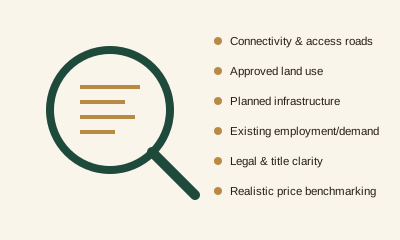
A six-point framework for evaluating any corridor
- Connectivity and access roads — is the connectivity confirmed and functioning today, or dependent on a project still in an early stage? See our coverage of how to read infrastructure news.
- Approved land use — is the corridor's land genuinely approved for the intended use, or does it rely heavily on informal development and pending conversions? See how to check land use.
- Planned infrastructure vs delivered infrastructure — water, sewage and power that exist today are worth more than promises of what's coming.
- Existing employment or demand drivers — a corridor near an established employment hub (like Mahindra World City on Ajmer Road) has a demand floor that purely speculative areas lack.
- Legal and title clarity — see our documents checklist and red flags guide.
- Realistic price benchmarking — compare asking prices against genuinely comparable, recently transacted properties in the same micro-pocket, not the wider corridor average.
| Signal | Stronger indicator | Weaker indicator |
|---|---|---|
| Infrastructure | Delivered / under active construction | Announced or proposed only |
| Demand driver | Existing employment hub or established residential base | Purely speculative, based on future potential |
| Land status | Approved land use, clear title | Pending conversion, unclear approval |
How we apply this at Yash Terra
Every corridor we recommend to clients is evaluated against this same six-point framework before it reaches a shortlist — not marketed on the strength of a single headline. For a deeper look at one corridor that consistently scores well against these factors, see our analysis of why Ajmer Road remains a strong investment corridor.
Want a corridor-by-corridor comparison for your budget?
Tell us your budget and goals, and we'll walk you through which corridors genuinely fit — with the fundamentals checked, not just the headline.
Key takeaway
An "emerging corridor" label is marketing language until it's backed by verified infrastructure, approved land use, genuine demand, clean title and realistic pricing. Apply the same six-point framework to every corridor you consider, regardless of how much buzz surrounds it.
Frequently Asked Questions
How do I know if a corridor's infrastructure is real or just promised?
Check the project's current stage — proposal, approval, tender, construction or completion — through official sources rather than relying on marketing claims alone.
Is an established employment hub more important than a new road project?
Both matter, but an existing employment or demand driver provides a demand floor that a purely proposed infrastructure project doesn't yet offer.
Should I compare prices across the whole corridor or a specific pocket?
Compare against genuinely comparable, recently transacted properties in the same micro-pocket — corridor-wide averages can obscure meaningful differences within it.
Sources & Further Reading
This article is general research and analysis, not legal, valuation or investment advice. Rules, approvals, project timelines and site-specific conditions can change. Readers should verify current records with the relevant authority before purchasing land, constructing, or relying on an infrastructure proposal.
Related Tools & Checklists
Free calculators and due-diligence checklists relevant to this topic — no sign-up required.